Target Detection and Material Mapping Processes
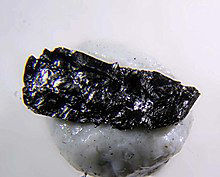
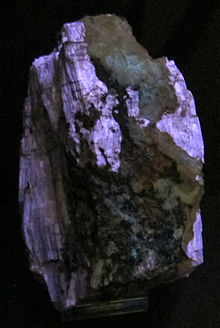
Abelsonite is semi-transparent and pink-purple, dark greyish purple, pale purplish red, or reddish brown in color. The mineral occurs as thin laths or plates or small aggregates up to 1 cm (0.39 in). The mineral is soluble in benzene and acetone and is insoluble in water, dilute hydrochloric acid, and dilute nitric acid.
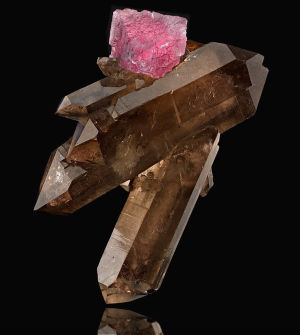
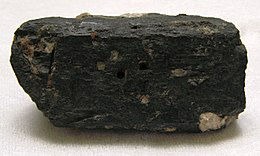
Abenakiite-(Ce) is a mineral of sodium, cerium, neodymium, lanthanum, praseodymium, thorium, samarium, oxygen, sulfur, carbon, phosphorus, and silicon. The silicate groups may be given as the cyclic Si6O18 grouping. The mineral is named after the Abenaki, an Algonquian Indian tribe of New England. Its Mohs scale rating is 4 to 5.
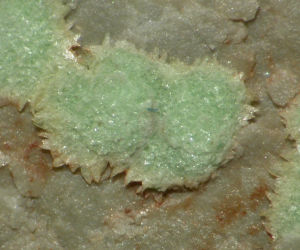
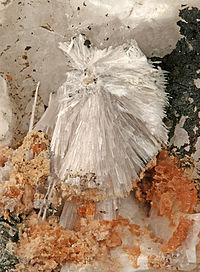
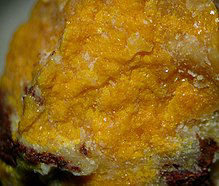
Abernathyite is a transparent, yellow mineral that occurs as tabular crystals up to 3 millimetres (0.12 in). The mineral has a single perfect cleavage on {001}. Abernathyite fluoresces yellow green in longwave and shortwave ultraviolet. Because of its uranium content, the mineral is radioactive.
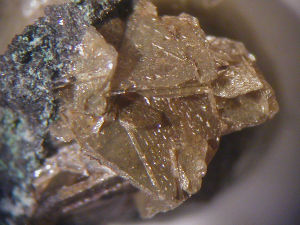
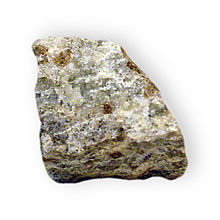
Abhurite is a mineral of tin, oxygen, hydrogen, and chlorine. It is named after its type locality, a shipwreck with tin ingots at Sharm Abhur, a cove near Jeddah in the Red Sea. Abhurite forms alongside other tin minerals like romarchite and cassiterite.
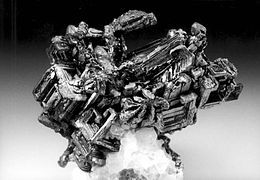
Abramovite is an exceedingly rare mineral from the sulfides and sulfosalt categories. It has the chemical formula Pb2SnInBiS7. It occurs as tiny elongated lamellar-shaped crystals, up 1 mm × 0.2 mm in size, and is characterized by its non-commensurate structure.
Abswurmbachite is a copper manganese silicate mineral. It was first described in 1991 and named after Irmgard Abs-Wurmbach (born 1938), a German mineralogist. It crystallizes in the tetragonal system.
Acanthite is a form of silver sulfide with the chemical formula Ag2S. It crystallizes in the monoclinic system and is the stable form of silver sulfide below 173 °C (343 °F). Argentite is the stable form above that temperature. As argentite cools below that temperature its cubic form is distorted to the monoclinic form of Acanthite. Below 173 °C Acanthite forms directly. Acanthite is the only stable form in normal air temperature.
Achávalite is a selenide mineral that is a member of the nickeline group. It has only been found in a single Argentinian mine system, being first discovered in 1939 in a selenide deposit. The type locality is Cacheuta mine, Sierra de Cacheuta, Mendoza, Argentina.
Actinolite is an intermediate member in a solid-solution series between magnesium-rich tremolite, and iron-rich ferro-actinolite. Mg and Fe ions can be freely exchanged in the crystal structure. Like tremolite, asbestiform actinolite is regulated as asbestos.
Acuminite is a rare halide mineral of with chemical formula: SrAlF4(OH)·(H2O). Its name comes from the Latin word acumen, meaning "spear point". Its Mohs scale rating is 3.5.
Acumenite has only been described from its type locality of the cryolite deposit in Ivigtut, Greenland.
Adamite is a zinc arsenate hydroxide mineral, Zn2AsO4OH. It is a mineral that typically occurs in the oxidized or weathered zone above zinc ore occurrences. Pure adamite is colourless, but usually it possesses yellow color due to Fe compounds admixture. Tints of green also occur and relate to copper substitutions in the mineral structure. Olivenite is a copper arsenate that is isostructural with adamite and there is considerable substitution between zinc and copper resulting in an intermediate called cuproadamite. Zincolivenite is a recently discovered mineral being an intermediate mineral with formula CuZn (AsO4) (OH). Manganese, cobalt, and nickel also substitute in the structure. An analogous zinc phosphate, tarbuttite, is known.
Adamsite-(Y) (previously IMA 1999-020), chemical formula NaY (CO3)2·6H2O is a mineral of sodium, yttrium, carbon, oxygen, and hydrogen. It is named after Frank Dawson Adams (1859–1942), professor of geology, McGill University. Its Mohs scale rating is 3.
The rare mineral adelite, is a calcium, magnesium, arsenate with chemical formula CaMgAsO4OH. It forms a solid solution series with the vanadium-bearing mineral gottlobite. Various transition metals substitute for magnesium and lead replaces calcium leading to a variety of similar minerals in the adelite - duftite group. Adelite forms variably coloured (blue, green, yellow, and grey) crystals in the orthorhombic crystal system. The form is typically massive. It has a Mohs hardness rating of 5 and a specific gravity of 3.73 to 3.79. It was first described in 1891 from Värmland, Sweden. Its name comes from the Greek word for indistinct.
Admontite is a hydrated magnesium borate mineral with formula MgB6O10·7H2O. Occurrence - In a gypsum deposit. Associations: gypsum, anhydrite, hexahydrite, löweite, eugsterite, pyrite, quartz. It is named after Admont, Austria. Its Mohs scale rating is 2 to 3.
Aegirine is a member of the clinopyroxene group of inosilicate minerals. Aegirine is the sodium endmember of the aegirine-augite series. Aegirine has the chemical formula NaFeSi2O6 in which the iron is present as Fe3+. In the aegirine-augite series the sodium is variably replaced by calcium with iron (II) and magnesium replacing the iron (III) to balance the charge. Aluminium also substitutes for the iron (III). Acmite is a fibrous, green-coloured variety.
Aenigmatite, also known as Cossyrite after Cossyra, the ancient name of Pantelleria, is a sodium, iron, titanium inosilicate mineral. The chemical formula is Na2Fe2+5TiSi6O20 and its structure consists of single tetrahedral chains with a repeat unit of four and complex side branches. It forms brown to black triclinic lamellar crystals. It has Mohs hardness of 5.5 to 6 and specific gravity of 3.74 to 3.85. Aenigmatite forms a solid-solution series with wilkinsonite, Na2Fe2+4Fe3+2Si6O20.
Aerinite (Ca4(Al, Fe, Mg) 10Si12O35 (OH) 12CO3·12H2O) is a bluish-purple inosilicate mineral. It crystallizes in the monoclinic system and occurs as fibrous masses and coatings. It has a dark, vitreous lustre, a specific gravity of 2.48 and a Mohs hardness of 3. It is a low-temperature hydrothermal phase occurring in zeolite facies alteration of mafic rocks. Associated minerals include prehnite, scolecite and mesolite. Its name comes from a Greek root "aerinos," meaning "atmosphere" or "sky".
Aerugite is a rare complex nickel arsenate mineral with a variably reported formula: Ni9(AsO4)2AsO6. It forms green to deep blue-green trigonal crystals. It has a Mohs hardness of 4 and a specific gravity of 5.85 to 5.95.
It was first described in 1858 in either the South Terres mine of Cornwall, England or in Erzgebirge, Saxony, Germany. The origin is disputed. The most common occurrence is as an incrustation on furnace walls in which ores are roasted. Its name comes from the Latin word aerugo for copper rust.
Aeschynite-(Ce) (or Aschynite, Eschinite, Eschynite) is a rare earth mineral of cerium, calcium, iron, thorium, titanium, niobium, oxygen, and hydrogen with formula: (Ce,Ca,Fe,Th)(Ti,Nb) (O,OH). Its name comes from the Greek word αισχύνη ("aeschyne") for "shame" because early chemists had difficulty with separations of titanium from zirconium.
The "-(Ce)" means it has more cerium than the yttrium variety aeschynite-(Y). Its Mohs scale rating is 5-6.
Aeschynite-(Nd) is a rare earth mineral of neodymium, cerium, calcium, thorium, titanium, niobium, oxygen, and hydrogen with formula: (Nd,Ce,Ca,Th)(Ti,Nb)(O,OH). Its name comes from the Greek word for "shame". Its Mohs scale rating is 5 to 6. It is a member of the hydroxide minerals. It was first reported for an occurrence in Bayan Obo Inner Mongolia in 1982. In that rare earth mining deposit, it occurs in veins within metamorphosed dolomite and slate. It occurs associated with aegirine, riebeckite, barite, fluorite, albite, phlogopite and magnetite.
Aeschynite-(Y) (or Aeschinite-(Y), Aeschynite-(Yt), Blomstrandine, Priorite) is a rare earth mineral of yttrium, calcium, iron, thorium, titanium, niobium, oxygen, and hydrogen with formula: (Y,Ca,Fe,Th)(Ti,Nb)2(O,OH). Its name comes from the Greek word for "shame". Its Mohs scale rating is 5 to 6.
Afghanite, (Na,K)22Ca10[Si24Al24O96](SO4)6Cl6, is a hydrous sodium, calcium, potassium, sulfate, chloride, carbonate alumino-silicate mineral. Afghanite is a feldspathoid of the cancrinite group and typically occurs with sodalite group minerals. It forms blue to colourless, typically massive crystals in the trigonal crystal system. The lowering of the symmetry from typical (for cancrinite group) hexagonal one is due to ordering of Si and Al. It has a Mohs hardness of 5.5 to 6 and a specific gravity of 2.55 to 2.65. It has refractive index values of nω=1.523 and nε=1.529. It has one direction of perfect cleavage and exhibits conchoidal fracture. It fluoresces a bright orange. It was discovered in 1968 in the Lapis-lazuli Mine, Sar-e-Sang, Badakhshan Province, Afghanistan and takes its name from that country. It has also been described from localities in Germany, Italy, the Pamir Mountains, Tajikistan, near Lake Baikal in Siberia, New York, and Newfoundland. It occurs as veinlets in lazurite crystals in the Afghan location and in altered limestone xenoliths within pumice in Pitigliano, Tuscany, Italy. It is used as a gemstone.
Afwillite is a calcium hydroxide nesosilicate mineral with formula Ca3(SiO3OH)2·2H2O. It occurs as glassy, colourless to white prismatic monoclinic crystals. Its Mohs scale hardness is between 3 and 4. It occurs as an alteration mineral in contact metamorphism of limestone. It occurs in association with apophyllite, natrolite, thaumasite, merwinite, spurrite, gehlenite, ettringite, portlandite, hillebrandite, foshagite, brucite and calcite. It was first described in 1925 for an occurrence in the Dutoitspan Mine, Kimberley, South Africa and was named for Alpheus Fuller Williams (1874–1953), a past official of the De Beers diamond company. Afwillite is typically found in veins of spurrite and it belongs to the nesosilicate sub-class. It is monoclinic, its space group is P2 and its point group is 2.
Agardite is a mineral group consisting of agardite-(Y), agardite-(Ce), agardite-(Nd), and agardite-(La). They comprise a group of minerals that are hydrous hydrated arsenates of rare-earth elements (REE) and copper, with the general chemical formula (REE,Ca)Cu6(AsO4)3(OH)6·3H2O. Yttrium, cerium, neodymium, lanthanum, as well as trace to minor amounts of other REEs, are present in their structure. Agardite-(Y) is probably the most often found representative. They form needle-like yellow green (variably hued) crystals in the hexagonal crystal system. Agardite minerals are a member of the mixite structure group, which has the general chemical formula Cu2+6A(TO4)3(OH)6·3H2O, where A is a REE, Al, Ca, Pb, or Bi, and T is P or As. In addition to the four agardite minerals, the other members of the mixite mineral group are calciopetersite, goudeyite, mixite, petersite-(Ce), petersite-(Y), plumboagardite, and zálesíite. Agardite-(Y) from the Bou Skour mine in Djebel Sarhro, Morocco was the first of the agardite-group minerals to be characterized. It was described by Dietrich in 1969 and was named after Jules Agard, a French geologist at the Bureau de Recherches Géologiques et Minières, Orléans, France. Agardite-group minerals have subsequently been found in Germany, Czech Republic, Greece, Italy, Japan, Namibia, Poland, Spain, Switzerland, the United Kingdom, and the United States.
Agrellite (NaCa2Si4O10F) is a mineral found in Quebec, Canada and a few other locations. Agrellite displays pink fluorescence under both shortwave and longwave ultraviolet light. It is named in honour of Stuart Olof Agrell (1913–1996).
Agrinierite (K2(Ca,Sr)(UO2)3O3(OH)2·5H2O) is a mineral often found in the oxidation zone of uranium deposits. It is named for Henry Agrinier (1928–1971), an engineer for the Commissariat à l'Énergie Atomique.
Aguilarite is an uncommon sulfosalt mineral with formula Ag4SeS. It was described in 1891 and named for discoverer Ponciano Aguilar. Aguilarite is bright lead-gray on fresh surfaces but becomes dull iron black when exposed to air. The mineral occurs with massive habit, as elongated pseudododecahedral crystals up to 3 cm (1.2 in), or as intergrowths with acanthite or naumannite.
Aheylite is a rare phosphate mineral with formula (Fe2+Zn)Al6[(OH)4|(PO4)2]2·4(H2O). It occurs as pale blue to pale green triclinic crystal masses. Aheylite was made the newest member of the turquoise group in 1984 by International Mineralogical Association Commission on New Minerals and Mineral Names.